For many in Northern Ireland there is a level of cynicism in the new deal resulting in the Northern Ireland Assembly and Executive returning to Stormont. Why? After three years away from government many have been left wondering what the difference was being made, however it is better to have a government than not, regardless of those doubts. What is driving this concern is the fallout from the Renewable Heat Incentive scheme (Sam McBride’s Burned is essential reading) and the undignified scramble for money from the UK Treasury. Vince Lombardi, the legendary NFL coach said, “the measure of who we are, is what we do with what we have”, how that contrasts with the apparent cake and eat it approach we are hearing. The estimate from Esmond Birnie in the Belfast Telegraph (January 14, 2020) is a whopping £5billion GBP with water and roads being where the big-ticket items exist. This is coupled with reform needed in our health and education systems. The focus has been primarily on the disappointment of the key members of the NI Executive in not being offered a massive subvention by Westminster with the NI Secretary of State offering a firm rebuttal to the NI parties. The failure of the parties to countenance any form of revenue raising activity or deep long-term reform is all driving the cynicism and lack of public joy at our politicians being back on the hill. So, what would make a difference? A look at a complex interdependent issue like social mobility sheds light on the wide range of opportunities and challenges the Assembly and Executive need to look at to build a positive relationship with the voters of Northern Ireland. Over the weekend the World Economic Forum published its Global Social Mobility Report, listing a range of items that act as a drag of social mobility. It covers key elements that appear to some extent within the New Decade, New Approach, including health, education, technology access and economic success. At the same time as this an interesting and closely linked discussion has come about around the potential of raising of student tuition fees, with it being point blank rejected by some, used to challenge opportunity for those from lower socio-economic groups and be a driver in forcing students to study in other parts of the United Kingdom or the Republic of Ireland. Do we need so many university places, what is their currency in the marketplace, are they adding value to the learner or employers and is there other ways to develop the skills and knowledge needed for the world of work? The New Decade, New Approach deal focuses on a number of key issues, anti-poverty, integrated education and on the basis of a “shared and ambitious strategic vision for the future with the aim of improving wellbeing for all – by tackling disadvantage and driving economic growth on the basis of objective need.”
But with limited resources how can the executive make this work? Let’s look at how some solutions could potentially be delivered and make a real difference;
Business cannot hand this work over to government and wring its hands until some sort of funding is provided. Much has been said about social dialogue and partnership, that is absolutely essential but coupled with that business must take ownership of the issues above and in delivering this will address a key element of the productivity and move a step closer to answering the lack of social mobility in Northern Ireland. Business can directly work to find the 22% of the Northern Ireland workforce that is underutilized better roles, while the 16% that have no qualifications who are in work could be supported by the NI Executive addressing the loss of £60m GBP from the NI economy each year in the apprenticeship levy. Yet not a single party in NI has even considered this as an important issue to challenge Julian Smith and HM Treasury on. Considering 45% of those paying in England aren’t using the funds, where is the money going? . The net outcome of a productivity boost? In basic terms in excess of £2 billion GBP to NI economy if every business in bottom 3 quartiles improved productivity by 10%, this transformative and would enable investment in infrastructure and technology that would accelerate the pace of change. Peter Drucker said “The best way to predict the future is to create it” – we can do that with productivity, the question is who is up for it? Graphics and credits to Slugger O’Toole, Belfast Telegraph and World Economic Forum – thanks and apologies
1 Comment
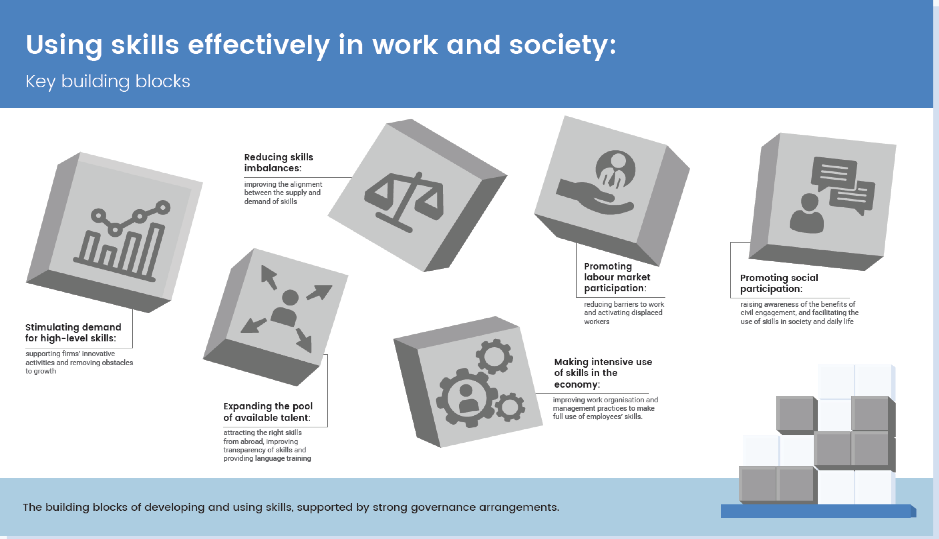
Trust is the delicate invisible fabric that holds all relationships together. Damage, cut or fray one thread and the fabric quietly unravels. In business, in relationships both intimate and distant, in conversation, in government, education, dare I mention places of worship, throughout our lives, trust is the fabric that holds relationships together. Or not. We have seen this fabric unravel across society in many ways, in business it ultimately leads to the loss of customers, colleagues, revenue and business failure. Here are some ways the invisible fabric of trust is unraveled – many will have experienced and acted these behaviours. This is noted here, not to throw stones, but to warn aspiring leaders, personal experience is a hard task master. Saying one thing; doing another: The fabric of trust is weakened when we act contrary to our words. Our words are an outward expression of our intentions, but if we say one thing and do another thing it is hard for people to identify the real person behind the words. Uncertainty breeds wariness, another word for mistrust. While the loss of one thread may not matter a great deal, the dissonance between our words and actions over time causes more threads to unravel, and the fabric grows very, very weak. Disingenuous speech: Words that reek of any ‘-ism’ are words that tear at the fabric of trust. What we say matters. Harsh words, abusive language, and sarcastic jokes in the presence of others do serious damage to the invisible fabric of trust. Making promises that cannot be kept: Your track record is the measure of your credibility. Overpromising may make you look good in a meeting, but incomplete projects are monuments, not trophies. People know who will get things done, and they also know those who merely talk a good game. If you cannot fulfill your promises, you tear a gaping hole in the invisible fabric of trust. Young leaders are especially tempted to overpromise to get a name for themselves. Be careful not to damage your credibility too early in your career through this mistake. Refusing to apologize after relationships have been damaged: The only possible way for a patch to be sewn on the fabric of trust is through a true apology. An apology can repair the fabric of trust, but like a piece of cloth, there will always be evidence that it was once torn. There are many, many books on the value of trust in leadership … for good reason. For many, the greatest compliment anyone can provide in business is “I trust you to get this done.” When as individuals or organisations earn trust, they begin to earn confidence and from that influence. President Dwight D Eisenhower expressed it like this, “…the supreme quality for a leader is, unquestionably, integrity…” While doing the opposite of what has been said above will help maintain trust, to build and strengthen that fabric of trust we could add some things that as leaders we could practice. Exemplify humility: people won’t trust you if you see you are driven by ego, jealousy or a belief that you are better than they are. Demonstrate your support for others: Zig Ziglar said “help enough people to succeed, and you will succeed also.” Nothing develops or displays your character and builds trust than putting others first. Encourage two-way participation with the people you want to influence: trust creates circumstances where people will listen to you and follow you. Listening, not just hearing, is a gift few leaders truly have. When we do this as leaders however we will have included others in our personal or organisational success do we find it having that longevity that is so often lacking. For the future good of the Northern Ireland economy we need to better anticipate change, build resilience and develop a broader set of skills and proficiency. We need to reinvent the way people learn and interact with each-other to get the best out of new technologies and innovative ways of working, so more businesses are productive, and more people can progress and prosper to drive inclusive growth. We are bombarded with articles and events on how to survive in the age of automation, the future of work, the rise of the robot and AI along with the skills pipeline. “Skills empower economies, business and people to thrive in our increasingly interconnected and rapidly changing world” (OECD Skills Strategy 2019 – Skills to Shape a Better Future). This is undoubtedly true, the question arises then, how as leaders do we take the right approach? How do we develop the right skills and how do we us these skills fully and effectively? Skills matter for individual wellbeing and national prosperity, as we have seen from recent events the need to have skills flexibility in our economy is growing rapidly. Our education and training systems are based on a linear process leading to a career. This is now proving unable to support the pace of disruptive technology, the changing face of manufacturing and the very definition of work itself. When we look at key megatrends the challenge is clear:
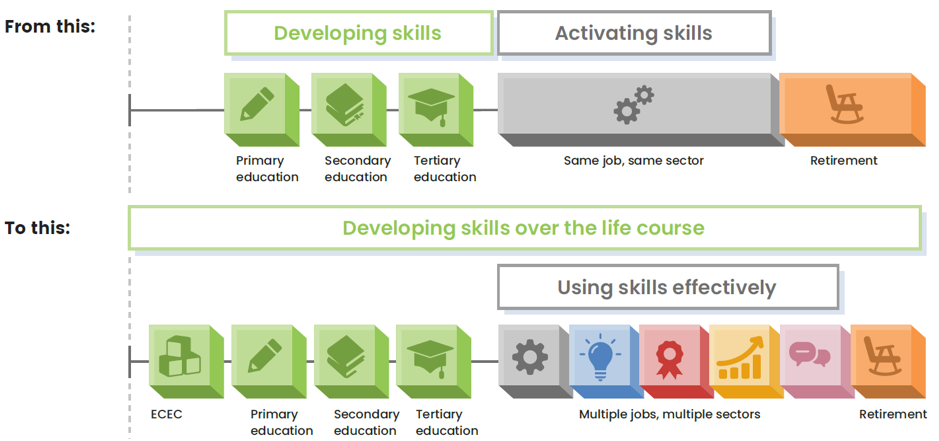
Investment in skills and developing the relevant ones over the life course is now a significant challenge for policy makers, business and individuals. The focus of improving educational outcomes has led to a loss of focus on developing wider skills needed for a very fluid and flexible labour market able to address these significant megatrends. In Northern Ireland there is rightly a focus on increasing R&D investment. Certain sectors are now finding that having done this that tertiary along with vocational education and training is struggling to tailor its offering (primarily by being starved of resource). This is leading to innovation strategies being curtailed or failing to have impact. Developing skills over the life course of all in work, rather than reskilling after loss of work is now a key challenge to business in Northern Ireland. The development of social partnership, investment in our management and leadership skills (our IoD NI Academy programme addresses this fully) coupled with investment in our FE Colleges and Universities can enable this. It will be essential that business takes the lead in supporting this change, fully engaging in every opportunity to reform and being the first mover where possible. Graphics credit - OECD Skills Strategy 2019: Skills to Shape a Better Future Northern Ireland business start-ups and innovative SME’s have been a bright spot over the last few years. Scaling those businesses and organisations and sustaining that success has proved harder. There is no “one size fits all” solution to this challenge, some will point to fiscal issues, others to foreign market engagement or availability of capital. While all of these are certainly issues we face in Northern Ireland often to the owner / manager they are distant to them and the day to day elements of running a start-up or SME.
Recently I attended an event in London which involved some short talks from leading business and academic figures trying to address the growth challenge and practical way. What follows is some of the thoughts of Sir Charlie Mayfield (John Lewis Partnership), Phil Smith (Cisco), Tony Danker (Be the Business), Professor Veronica Hope Hailey (Bath University) and Hosein Khajeh-Hosseiny (Philanthropist & McKinsey). Some of the notes I took you look back and say they are hardly revolutionary, but if you are in the thick of it then having someone highlight it could be the difference you need. Scaling Challenge The issues in growth can be identified as psychological and technical readiness. Being able to identify these is the kernel of these two elements overlaps, commitment. Failure to commit fully at start up would have seen failure, why would it be any different when scaling. Whether that means commitment psychologically to a challenge or technically to the next opportunity put everything into it. From a psychological position that will also require courage, Winston Churchill is quoted as saying “Fear is a reaction, courage is a decision” that is most certainly true while endeavouring to scale. Candor, that ability to be honest, is a vital element, with yourself, your colleagues, your customers and with your family. Technically readiness and that commitment to a new opportunity or improve a current process while vital having built pockets of greatness in the business or commitments. This was primarily highlighted by Jim Collins in his 2001 book “Good to Great” where he advocated that at all levels of a business or organisation creating a culture of being willing to take action to develop or address issues was a key element of growing any business. Vision A well worn path, as you grow your organisation this can often become lost or diluted and direction lost. This may seem elementary but without taking time to refresh and refocus on the vision we can quickly veer off course.
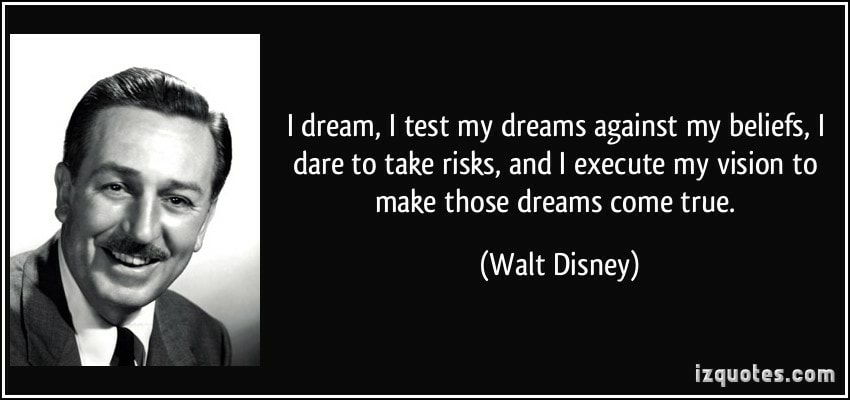
Imperative of Empowement Often the reason businesses stagnate and don’t move to the next level is that we see the business and everything associated with it as a place of fear and risk, a place of task rather than of passion. That permeates the organisation that it stagnates creativity and innovation, team members and leaders alike no longer get the opportunity to discover what you are good or bad at. They no longer see the business as a place to fulfil their passions and develop. Empowerment is vital in the modern business environment, technology is changing the workplace and the world, greater power lies in the individual and not in top down structures. Coupled with this the expectations and definition of what work itself is changing and therefore empowering those we work with can make a real difference. Share knowledge and learning, it will amaze you what you get in return. Enable team members to grow, kill the command and control structures. Show purpose in the workplace, does the business have one? Be a Better Leader Easier said than done, however it is an essential element of developing and sustaining any business or organisation. As the Institute of Directors Leadership & Management Ambassador in Northern Ireland I would urge you to get on board, this is our purpose. If you are a member our professional development will help you with this, take a look at our digital academy, there is lots of bitesize bits of knowledge and wisdom. At the heart of being a better leader is trust, if your team, customers, stakeholders cannot trust you all else will be wasted. Veronica Hope Hailey summed that up perfectly – trust in ability, benevolence, integrity and predictability. A great list to support being a better leader, takes time to build, but just a moment to shatter. Walt Disney was a showman, he has the most academy award nominations in history and his original Disneyland and Disneyworld theme parks are truly magical kingdoms, for adults, as well as for children. Over the past month Disney movies have dominated the movies both on television and in the cinema, with Mary Poppins Returns leading the way. But Walt Disney wasn’t just a showman he was a visionary and leader that pioneered and went where others had not even dreamed to go. In his seminal book “21 Indispensable Qualities of a Leader” the final quality he lists is vison, and he states, “A great leader’s courage to fulfill their vision comes from passion, not position.” Vision is therefore everything for a leader, it leads the leader, it paints the target, it sparks and fuels the fire within, drawing the leader forward and it is also the fire lighter for others who follow that leader. Based on some of his most well know quotes are a few thoughts around vision and leadership, often in short supply but is without doubt the lifeblood of every leader and their organization. Dream Big “If you can dream it, you can do it.” What if money, time, looks, and gender were no object? What would your biggest dream be? Often, we short-change ourselves. We listen to other people putting us or our organisations down, and internalise them. It’s hard to remember our dreams. Harder still, to imagine that we could achieve a dream. Take Walt Disney’s words to heart. Start dreaming. Then believe that you can achieve your dream. Be Grateful “The more you are in a state of gratitude, the more you will attract things to be grateful for.” What are you grateful for? We all have endless reasons to be grateful. What do you take for granted? Chances are that you’re blasé about your health, your comfortable home, your loving family, and about your job. Even if you have none of those things, you can be grateful for being alive. Studies have shown that gratitude improves your health, your relationships, and makes you happier. Be Courageous“All our dreams can come true, if we have the courage to pursue them.” It takes courage to step outside your comfort zone. However, achieving your dreams always means that you’re doing things you’ve never done before. Practice being courageous. Today, do something you haven’t done before. Propose a new project to your boss. Ask that question. Start writing that business plan for that idea that has been rattling around in your head for months. Being courageous doesn’t mean that you’re unafraid. It means acting in spite of your fear. Be Yourself “The more you like yourself, the less you are like anyone else, which makes you unique.” We all wear masks. We try to be what we think people want us to be. We try to emulate role models. What if you were just yourself? Discovering who you are underneath all the masks is challenging. It’s hard to be authentic if you’re not sure who you are. Just for today, be yourself. Say what you mean, rather than saying what you think someone wants to hear. However, be appropriate—being “like yourself” isn’t a license to be outrageous, or to say hurtful things. Embrace Competition. “I have been up against tough competition all my life. I wouldn’t know how to get along without it.” Competition is essential to help you to achieve your dreams. If there were no competition, you’d have nothing against which to measure yourself. Competition makes you better and stronger than you might otherwise be. In business, competition fosters innovation. If you’re uncomfortable with competition, or envious of competitors, ask yourself why, maybe your vision needs adjusted? Don’t Quit. “The difference in winning and losing is most often… not quitting.” You can’t succeed at anything without failing and failing a lot. Failure is the way we learn, it is why it is so important we change our education system and embrace experiential learning. Here’s what Thomas Edison said: “The three great essentials to achieve anything worthwhile are, first, hard work; second, stick-to-itiveness; third, common sense.”Everyone fails their way to success. Look on your failures as speed bumps in your journey towards success and keep going. Don’t quit, and if you haven’t watched it, take some timeout and watch “Saving Mr. Banks” Disney just would not quit! |
AuthorMark Huddleston is MD, Non-Exec, Skills, Employability & Productivity Advocate. Providing support to regional / local government and SME's Archives
June 2025
Categories |


RSS Feed